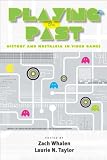
Playing the Past brings together a group of interdisciplinary scholars to examine the complementary notions of history and nostalgia as they are expressed through video games and in gaming culture. The scope of these related concepts moves from the personal to the cultural, and essays in this collection address video game nostalgia as both an individual and societal phenomenon, connecting the fond memories many of us have of classic gaming to contemporary representations of historical periods and events in video games. From Ms. Pac-Man and Space Invaders to Call of Duty and JFK: Reloaded, the games many of us have played since childhood inform how we see the world today, and the games we make and play today help us communicate ideas about real world history. By focusing on specific games, historical periods and media ecologies, these essays collectively take an in depth look at the related topics of nostalgia for classic gaming, gaming and histories of other media, and representations of real history in video games.
Webster's bibliographic and event-based timelines are comprehensive in scope, covering virtually all topics, geographic locations and people. They do so from a linguistic point of view, and in the case of this book, the focus is on "Planets," including when used in literature (e.g. all authors that might have Planets in their name). As such, this book represents the largest compilation of timeline events associated with Planets when it is used in proper noun form. Webster's timelines cover bibliographic citations, patented inventions, as well as non-conventional and alternative meanings which capture ambiguities in usage. These furthermore cover all parts of speech (possessive, institutional usage, geographic usage) and contexts, including pop culture, the arts, social sciences (linguistics, history, geography, economics, sociology, political science), business, computer science, literature, law, medicine, psychology, mathematics, chemistry, physics, biology and other physical sciences. This "data dump" results in a comprehensive set of entries for a bibliographic and/or event-based timeline on the proper name Planets, since editorial decisions to include or exclude events is purely a linguistic process. The resulting entries are used under license or with permission, used under "fair use" conditions, used in agreement with the original authors, or are in the public domain.
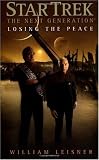
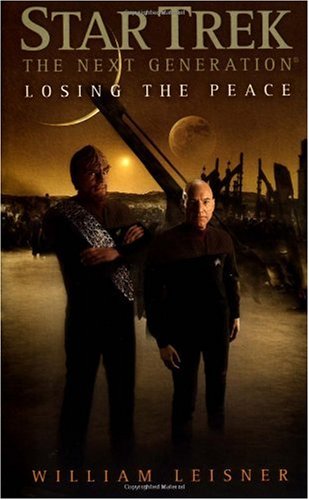
Star Trek: TNG: Losing the Peace (Star Trek, the Next Generation)
"After the catastrophic events of Star Trek: Destiny trilogy comes a time of reconstruction for the federal government and the individuals within it. Losing the peace follows the crew of the USS Enterprise-E, concerning the riots in the Federation and their personal lives in order to stabilize the work.
Unlike many recent books on Star Trek, and the antagonist in the peace not to lose a part of native species or a space anomaly, but the morale of the federal government. I liked this change of pace inwhat the characters have fear, pain and sadness in themselves and others, and turn the fine line of justice, to maintain during the chaos.
William Leisner wrote this novel trek with the purpose and authenticity. From the first chapter, I felt that Leisner exactly what he did, at any point, as he put feelings, backgrounds knew, and touching images that are both appealing and relevant to the story at hand. All the main characters act and speak truthform, and I liked the emphasis "comic" by Lt. Enterprise T'Ryssa Chen and the new cadet glive, injected a (not so) Tellarite fun. The end of the book is very moving for all Trek fans true.
My only concern of this book is that the act, while well written, is rather low. The story is a bit 'too easy and you never know I was on the edge of my seat with a real sense of urgency about what happens next. However, the plot was mildSaved by the rich array of characters and character interactions. Finally, I feel my duty as a Trekkie remiss if I did not report a serious faux pas: a historical note says that the events in this book takes place in 2361, when in fact take it in 2381 too.
All in all, lose the peace was a very good book. The rates on the high side to 4 stars just a hair away from 5 From the ashes of "Star Trek: Destiny, a whole new world of Trek-bed is availableemerge ... Go read it!"
Features of Star Trek: TNG: Losing the Peace (Star Trek, the Next Generation) :
ISBN13: 9781439107867
Condition: NEW
Notes: Brand New from Publisher. No Remainder Mark.
Overview :
Fortune has smiled on Lieutenant Jasminder Choudhury, chief of security on the U.S.S Enterprise.™ She has survived. But her homeworld, Deneva, one of the planets targeted in the massive Borg invasion, has not. The entire surface has been wiped clean of everything, killing anyone who did not evacuate and rendering the planet uninhabitable. Choudhury is left to wonder whether her family was one of the displaced. Or are they all gone forever?
The Enterprise is just one ship, and Jasminder Choudhury is just one officer, yet her story is being repeated over and over across the galaxy. Hundreds of thousands of displaced persons haunt the space ways, seeking comfort, looking for someplace safe, somewhere, anywhere to find solace. Captain Jean-Luc Picard is ordered to do everything he can to rescue and if need be to recover the lost souls from the Borg invasion.
For the first time in generations, citizens of the Federation know want, uncertainty, and fear. Bloodied yet unbowed, the Federation now stands on the edge of a precipice. The captain of the Enterprise finds himself in the unenviable position of wondering whether it is true that those who can win a war well can rarely make a good peace.