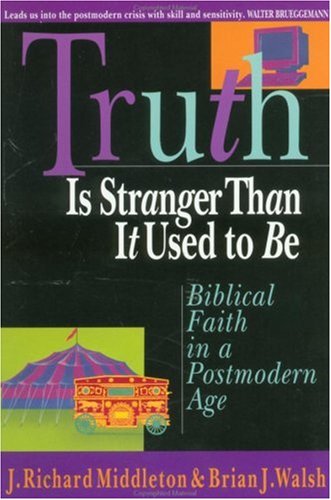
Truth Is Stranger Than It Used to Be: Biblical Faith in a Postmodern Age
Truth Is Stranger Than It Used to Be: Biblical Faith in a Postmodern Age
 |
"To some extent, the title says it all. Truth is stranger than it was before. Who would have thought that a book that is the paradigm of the postmodern intellectual and evangelical sense of the Bible seriously? Yet, here it is. Perhaps this is a testament both to the Bible resilency against the monumental paradigm shift in the cultural and intellectual history and a note on the other, that postmodernism is "hereresidence, and the different pieces that make up the intellectual postmodernism needs to be addressed and not ignored.
Middleton and Walsh authors ask in the first chapter, four key issues that have arisen in relation to the controversy over the honor of Columbus's discovery in 1992. While in the not too distant America, the 500th anniversary of Columbus 'journey' to the New World was announced as an historic success in increasing awareness of the postmodern, the different interpretations ofColumbus (the destruction of Native America, the original intention of colonialism and exploitation of resources, the fact that other fact, "discovered" America for the first time, etc.) guaranteed no particular view as dominated. This was a novelty - we no longer knew who we were. Who are we? Where are we? What happens? What is the remedy? These are the core issues, and in postmodern style, are deceptively simple in structure, and almost impossible to answer fully. DuringModern society could be, as always in progress, a sense of continuous development for the better since the failures of post-modernism of this - rich, and not always possible to improve the situation, science can not answer all the questions and indeed all the problems to solve, reason and intelligence and individuality are not non-qualified "assets" that the intelligence of their issue. But different is not only our worldview but are constructed and deconstructed, as the reality in different ways (can bea book on postmodernism that concerns Derrida? If so, it would be worth nothing?). The car is de-centered, and objective history and society has a different story - Middleton and important reference work Walsh Alistair MacIntyre, "After Virtue", which, although far from expected, a postmodern book, much of the recovery useful aspects of postmodernism interest in the old pre-modern. One of the concerns of postmodernism in relation to the narrative isThe distrust of universalizing and totalizing metanarratives nature, namely, that all things fall into a story that said the rule, one way. The authors of a stint as a bridge between the two main parts of the text to consider here, some important points that have an obvious problem - if the post-modern meta-narrative is suspect, how can Christianity and its companion works royal authority as one of the largest and most powerful metanarrativesThe history of mankind? Middleton and Walsh, according to the metanarratives pharmacological in nature - just take half and take the wrong dose, and is toxic, even lethal. One thing that is fundamental to the biblical authors of this project is not just a story now, but our history, something that not only we believe and confess, but in which we live. Biblical scholars as references and trible Brueggeman, Middleton and Walsh recognized the need to be honest aboutDiversity in the Holy Scriptures and the words sometimes terrible included. There is an overall chiastic structure of the book, as many passages of the Bible in both testaments. Middleton and Walsh look for standards and guidelines from the Bible - while it could be argued correctly identify that the post-modern-and-the-no or not Norma Normans. A criticism of Middleton and Walsh comprehensive approach is that they tend to see postmodernism as moremonolithic that it really is, maybe this is more for the structure and boundaries of the text, that their views real. Ultimately, see Middleton and Walsh in the biblical texts to prove, probably too liberal for most text to see the Bible as infallible. However, one could say that it is difficult for anyone in the texts Bible seriously, both as a document, and regarded as the living embodiment of God's word. Perhaps God, in God's own self, postmodernchallenge conventional notions of the Foundation and Sum - the fact that the things God created, God would not speak with them. A fascinating text." Customer Rating :
 List Price : $20.00
Offer Price : $9.79 Update Price ...

|
Overview :
Here is the book for those who wonder what postmodernism is and how biblical Christians might best respond to its challenges. In this book the authors survey postmodern culture and philosophy, offering lucid explanations of such difficult theories as deconstruction.
Reviews
a gospel stripped of its modern trappings - Darren Cronshaw - Melbourne, Australia
Richard Middleton and Brian Walsh, Truth is stranger than it was before: in 1995 the biblical faith in a postmodern world (Downers Grove: IVP)
Review by Darren Cronshaw
Middleton and Walsh provide a thick description and involved in our postmodern setting. They show how the demands of replicants of Blade Runner, which, as we want to know "where they came from, where to go and how long they have" got answers. With a wide range of items, suggestthat our carnival, cultural pluralism is the result of the collapse of modernity and the failure of the myth of progress, with a recognition of socially constructed reality connected: Truth is stranger than once.
The second half of the book tries to show the resources of Scripture, to connect in this context: Biblical faith in a postmodern world. Understanding the postmodern critique, they believe robbed a gospel of signs relevant modernHope and change our culture communicates chaotic. They describe life as a faithful Christian improvisation, not by rules, but the immersion in the text of a deep intuitive sense of history and author of the movement to win the intention to continue the adventure in an alternate world.
Originally Darren Cronshaw, "The Emerging Church appeared: introductory guide to reading ', Zadok Papers, S143 (Summer 2005).
Read more reviews ...
Similar Items
- The Gospel in a Pluralist Society
- Transforming Vision: Shaping a Christian World View
- The Shaping of Things to Come: Innovation and Mission for the 21 Century Church
- The Next Evangelicalism: Freeing the Church from Western Cultural Captivity
- Culture Making: Recovering Our Creative Calling

0 comments:
Post a Comment